A house in Westwood is close to a century old, which makes plumbing questions common. Slow drains, a gurgling toilet, a damp basement wall or a water heater that has run out of years all come up in houses of this age.
This page keeps three things apart. First, what public records say about Westwood. Second, general plumbing knowledge that applies to a house of this age. Third, what nobody has published, so we do not guess.
VerifiedWhat the public record says about Westwood
Cook County's hazard mitigation plan, in its section on Elmwood Park, says the Westwood subdivision was bought and developed in 1926. A Historic American Buildings Survey report fills in the detail. It describes a 243-acre tract in the northwest part of the village, between 76th and 80th avenues and between Belmont and Grand avenues.
The same report says the builder, Mills & Sons, broke ground on the first houses in February 1927 and largely finished the program by 1932. The houses were brick bungalows on about 1,689 lots, each 30 feet wide and 125 feet deep, with a one-car garage and a back yard.
General knowledgeWhat a house of this age can mean for plumbing
None of the following comes from a Westwood record. It is how we think about any house built around 1930.
Age tells us when, not what
A house finished in the early 1930s is now close to 95 years old. That does not tell us which pipe is in the wall or in the ground today, because pipes get repaired and replaced over time. We look before we say.
Narrow lots, close utilities
On a lot 30 feet wide, the water service, the sewer line and the gas line run close together between the street and the house. Call 811 before any digging so JULIE can mark buried utilities.
The garage and the back yard
If your garage has a drain, a utility sink or an outdoor hose connection, tell us when you call. Those small systems are easy to forget and sometimes need attention too.
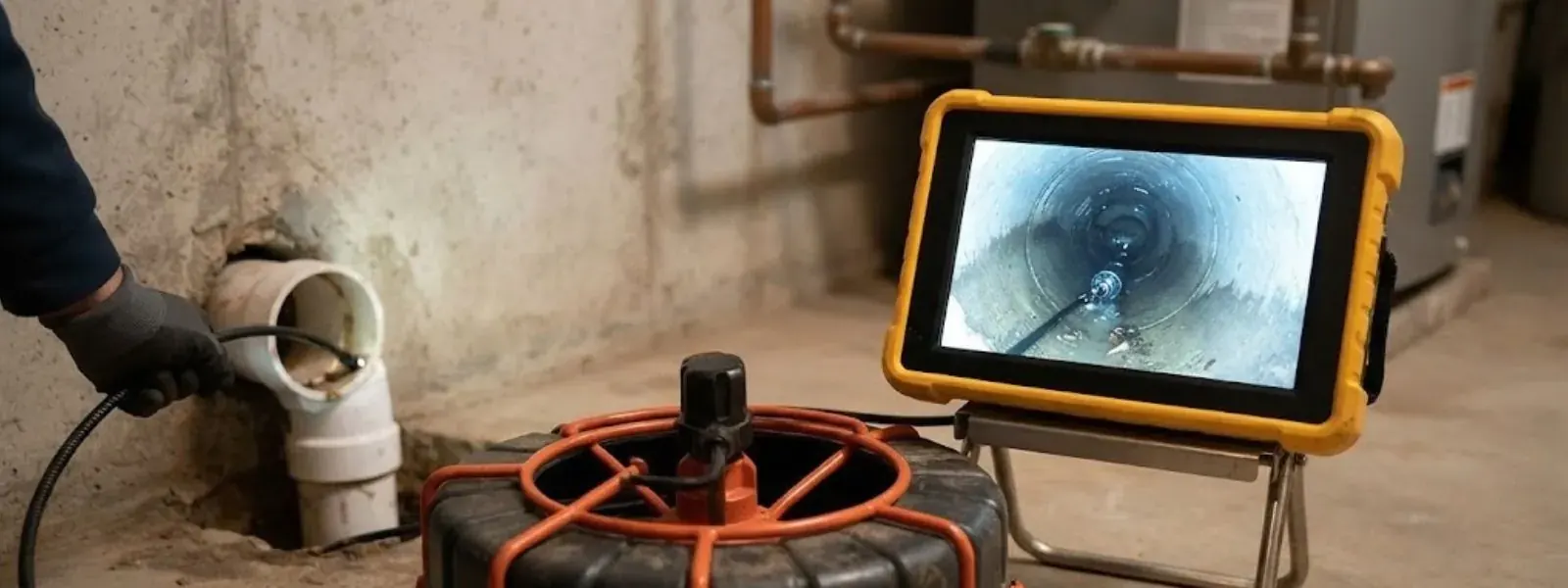
A camera answers the pipe question
Rather than guess what is under the floor, a sewer camera inspection shows the pipe, its joints and any roots or breaks.
Drain slow or a basement damp?
Call, name your cross streets and say what you see. A plumber will tell you what to try first.
Combined sewers and basement backups
The Village of Elmwood Park says it is served by combined sewers, and that these can back up into basements when they are under pressure in a heavy storm. That is a Village statement about the whole village, not a finding about any one street in Westwood.
When a storm pushes water up a floor drain, stop running water indoors and call us. We can clear your own line with drain cleaning, check it with a camera and talk through protection such as a backwater valve or a sump pump. Whether a given Westwood house has a basement is not in the records we found, so tell us what you have.
Who handles what in Westwood
Not every wet-floor problem is a plumber's job.
| What you see | Who handles it |
|---|---|
| Only your own drains are slow, gurgling or backing up | Us. A cable clears most clogs, and a camera helps if it keeps returning. See drain cleaning. |
| A damp patch, a hiss in the wall or a water meter that keeps moving | Us. See leak detection. |
| Water surfacing in the street or in several homes on the block | The Village, which runs the public sewers. |
| You smell gas | Walk out first. Then call your gas utility and 911 from a safe place. Your bill names the utility. |
| Questions about a permit | The Village building department at 11 West Conti Parkway. |
What we do not know about Westwood
We found no public record of which pipe materials sit in Westwood houses, how many have basements, or how many still have their original plumbing. We will not tell you your house has a certain pipe because of its age. A camera, a pressure check or a look at the water heater tells us far more.
We also did not find a published boundary for Westwood beyond the survey description above, so if you are unsure whether your street counts, just call. We serve all of Elmwood Park, and the next village to the west is River Grove.
Westwood plumbing questions
A Historic American Buildings Survey report places the Westwood tract in the northwest part of the village, between 76th and 80th avenues and between Belmont and Grand avenues.
Records say the first houses were started in 1927 and the program was largely finished by 1932. Individual houses may have been remodeled since, so age alone does not tell us what is inside the walls.
Yes. Call, give your cross streets and describe the problem. We do not promise an arrival time, because traffic and weather change it.
No public record answers that for a single house. A sewer camera inspection shows what is actually there.
The Village of Elmwood Park runs the public sewers. If water is coming up in your own house, call us as well, because your line may need clearing.
Standards and sources: Work in Illinois follows the Illinois Plumbing Code (77 Ill. Adm. Code 890), and the Village of Elmwood Park building department applies those minimum standards locally. Backup and flood guidance comes from the Metropolitan Water Reclamation District flood resource guide, which advises keeping only waste and toilet paper going down the toilet.